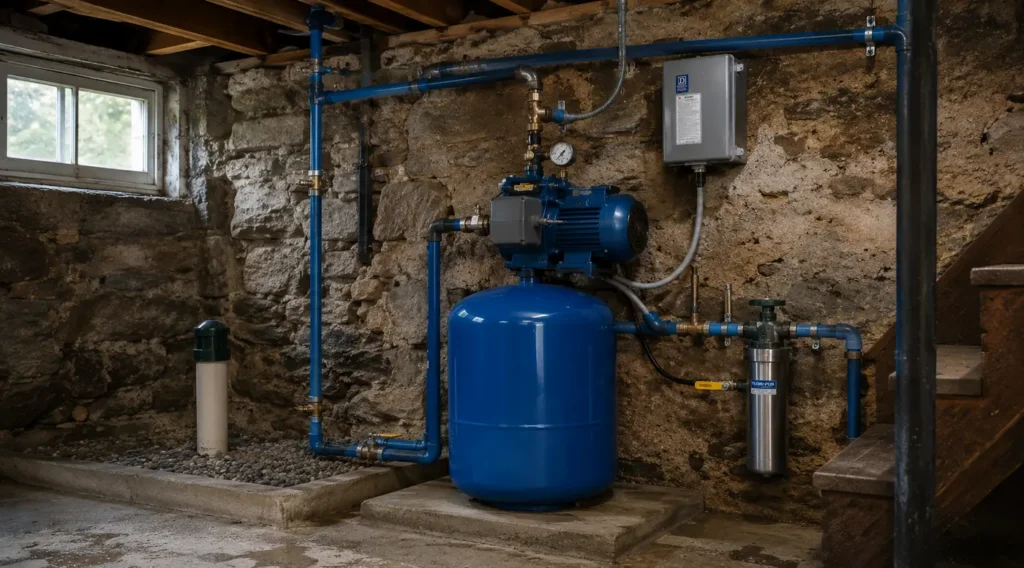
About a third of the time a homeowner calls us thinking the pump is failing, the actual culprit is the pressure tank. A waterlogged bladder tank, a corroded steel tank, or a tank that was undersized when it was first installed will make a perfectly healthy pump short-cycle itself to death. Replacing the tank is faster, cheaper, and stops the pump from getting blamed for a problem it didn’t cause.
There are two kinds of pressure tanks in Eastern Connecticut basements.
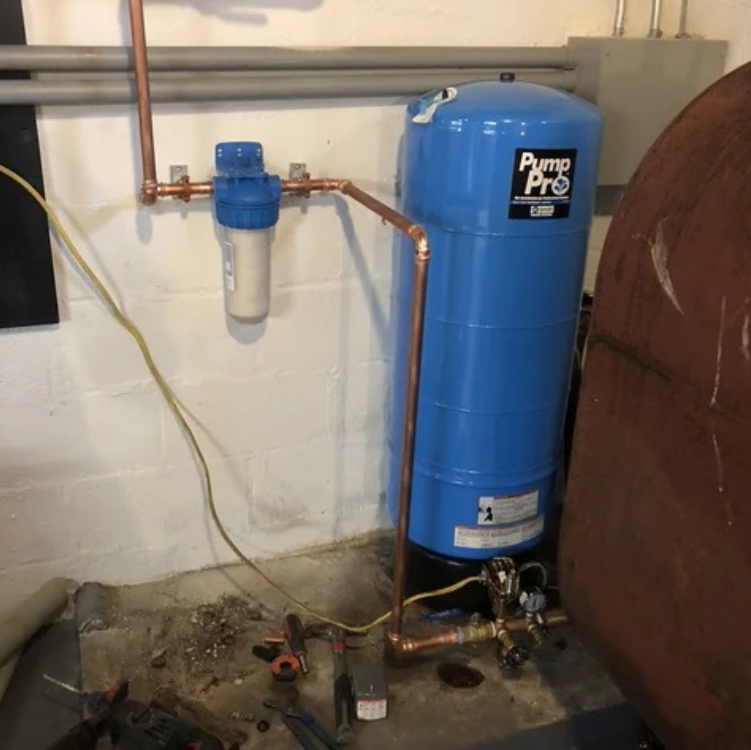
Bladder tanks (modern standard). A rubber bladder inside a steel shell separates air from water. The brand most installers use is Amtrol Well-X-Trol; we install those and a few comparable lines. Bladder tanks last 10 to 20 years if the pre-charge is checked annually. They’re sized by household demand, not by the pump: a typical family of four wants a 32-gallon (WX-202) or 44-gallon (WX-203) tank to keep the pump from cycling more than 30 times a day.
Steel galvanized tanks (legacy). No bladder, just an air pocket above the water. Common in homes built before about 1985. They work fine but they get waterlogged faster (the air dissolves into the water over time), require periodic air-charging, and rust through from the inside after 20 to 40 years. If you have one and it’s leaking from a pinhole, replace it with a bladder tank. Don’t patch it.
What we do on a tank swap: drain and isolate the old tank, replace the tank tee with a brass or no-lead bronze fitting, install a new pressure switch and gauge (cheap insurance — we never reuse), set the pre-charge to 2 psi below cut-in before any water hits the bladder, sanitize the line, and verify the switch cycle on a full draw-down. Constant-pressure buffer tanks are smaller and faster because they’re not holding the household reserve; they only buffer brief demand spikes.